A bottle designed to perfection means nothing if the ten-thousandth unit off the line no longer resembles the first. Manufacturing consistency is not a technical footnote — it is the foundation on which brand trust is built.
Introduction: The Gap Between Design and Delivery
Every fragrance brand begins with a vision. A founder sketches a silhouette, a designer refines a proportion, a sampling team approves a weight and feel. That approved sample — the one that passed every internal review — becomes the benchmark against which all future production must be measured.
The manufacturing challenge is not creating that first perfect bottle. It is creating the fifty-thousandth one with identical wall thickness, the same optical clarity, and the same precise neck diameter that guarantees a leak-free fit with the pump or cap. For global brands ordering across multiple production runs and shipping to multiple markets, this consistency is not a preference — it is a commercial requirement.
This article examines how precision glass manufacturing — from mold engineering through automated annealing — delivers the repeatability that allows brands to scale with confidence.
Part One: Mold Engineering — Where Consistency Begins
Every glass bottle starts as a mold. The accuracy of that mold determines the accuracy of every unit produced from it, which is why mold development is the most consequential investment in the entire manufacturing process.
The Mold Development Process
A production mold for a fragrance bottle is a precision-engineered steel tool, typically produced by CNC machining to tolerances measured in fractions of a millimeter. The process begins with converting a finalized 3D design file into mold geometry — accounting not just for the bottle’s external form, but for the behavior of molten glass inside the mold cavity.
Glass shrinks as it cools, and that shrinkage is not uniform across all surfaces and thicknesses. A mold that simply mirrors the target bottle geometry will consistently produce undersized or distorted units. Skilled mold engineers apply compensatory geometry — building in dimensional offsets that account for material behavior during cooling — so that the finished bottle, after full thermal stabilization, matches the approved specifications.
This expertise is not algorithmic. It is accumulated through experience with specific glass compositions, mold materials, and furnace conditions. It is one of the primary reasons that mold development should never be treated as a commodity service.
Mold Maintenance and Longevity
A production mold does not remain in perfect condition indefinitely. Thermal cycling — the repeated heating and cooling that occurs with every production cycle — gradually degrades the mold surface, introducing micro-variations that accumulate into visible quality drift over time. Rigorous mold maintenance protocols, including scheduled surface inspection and timely replacement of worn components, are essential to sustaining first-unit quality across the full production life of a mold.
Brands sourcing from manufacturers who defer maintenance to cut costs will encounter a familiar pattern: quality that is acceptable at the start of a production run and increasingly variable toward its end.
Part Two: The Automated Production Line
Modern fragrance glass manufacturing relies on automated production lines that remove human variability from the most critical forming stages. Understanding what automation controls — and what it cannot — helps brands ask the right questions when evaluating a manufacturing partner.
Furnace and Gob Formation
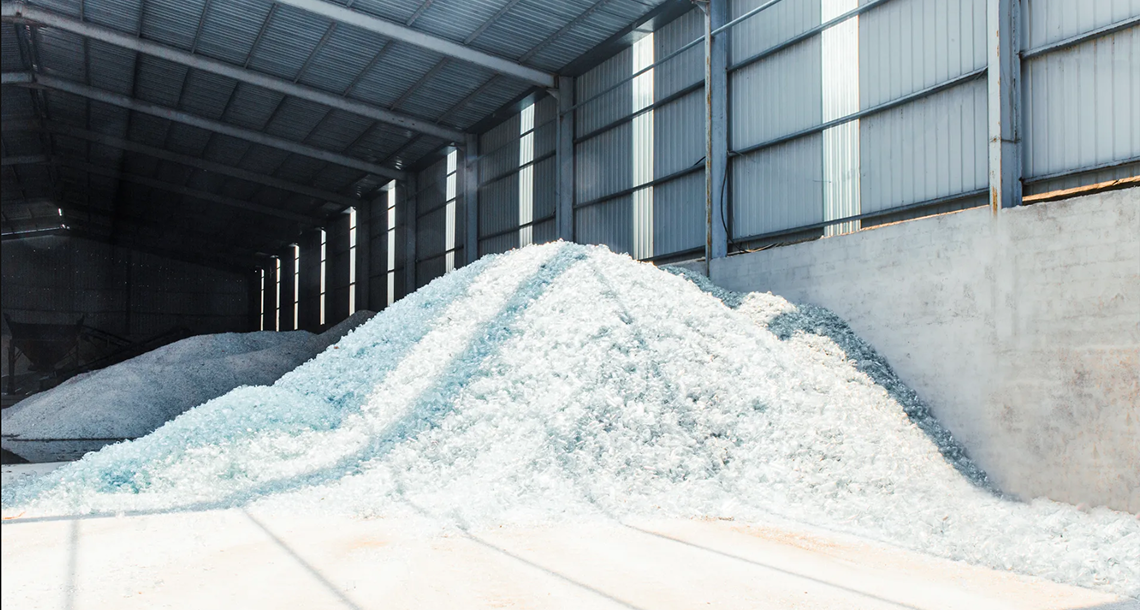
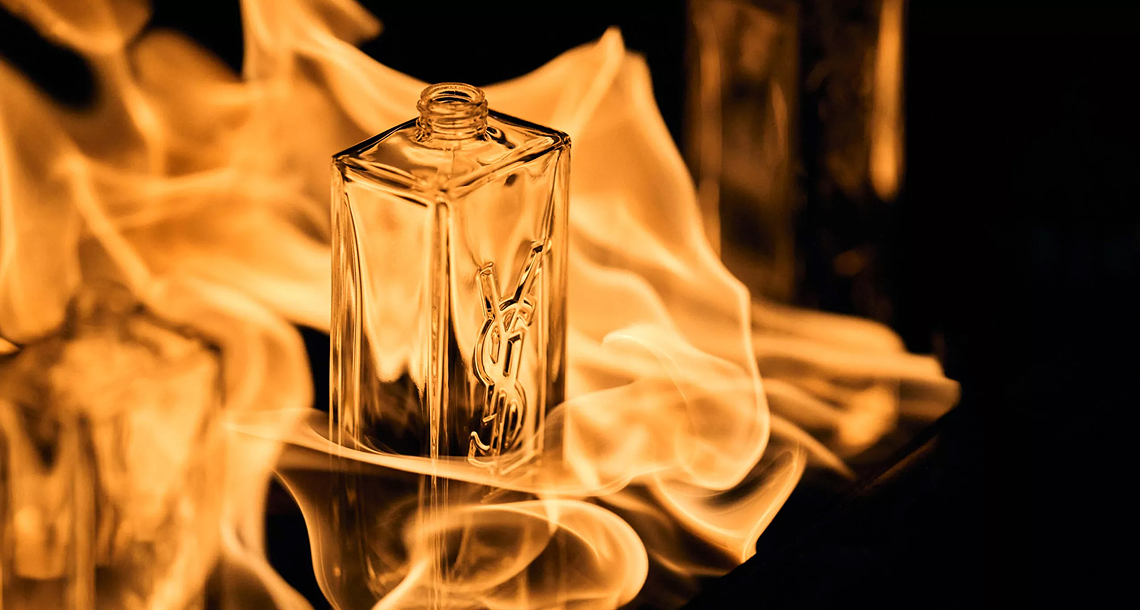
The process begins in the furnace, where raw batch materials are melted at temperatures exceeding 1,400°C into a homogeneous molten glass. The consistency of this melt — in temperature, viscosity, and chemical composition — determines the optical and structural properties of every bottle produced from it.
Gob formation, the process by which precise charges of molten glass are cut and delivered to the forming machine, is the first critical control point. Automated gob feeders regulate the weight and temperature of each gob to tight tolerances. Variation at this stage propagates through every subsequent process: a gob that is even marginally too heavy will produce a bottle with thicker-than-specified walls; one that is too cool will form unevenly, creating internal stress concentrations that compromise structural integrity.
Blow-and-Blow and Press-and-Blow Forming
Two primary forming methods are used in fragrance glass production, each suited to different bottle geometries.
Blow-and-blow forming uses compressed air in two sequential stages to shape the molten gob into the final bottle form. It is the standard method for narrow-neck bottles — the majority of fragrance vessel profiles — and produces consistent wall distribution when properly calibrated.
Press-and-blow forming uses a metal plunger to press the gob into the parison (the intermediate form) before the final blow. It offers superior wall thickness control for wide-mouth or heavy-based designs and is increasingly used for premium fragrance bottles where base weight and optical quality are differentiating factors.
In both cases, the automated forming line controls the critical parameters — air pressure, timing, mold temperature — with precision that no manual process can replicate at production scale.
Wall Thickness Uniformity: The Key Quality Metric
Of all the dimensional parameters that define a fragrance bottle’s quality, wall thickness uniformity is the most telling. It determines the bottle’s structural integrity under shipping stress, its optical consistency (uneven walls create distortion and color variation), and its tactile quality — the sensation of balanced, substantial weight that signals quality to the consumer.
Automated production lines achieve wall thickness uniformity through closed-loop control of the forming parameters. Inline measurement systems — typically using laser or contact-based gauging — sample bottles at defined intervals and feed data back into the process control system, allowing real-time correction before out-of-specification units accumulate.
The target specification for wall thickness uniformity varies by bottle design, but a manufacturing standard of ±0.2mm across the bottle body is a reasonable benchmark for fragrance-grade production. Brands should request wall thickness data — not just visual inspection results — when qualifying a new manufacturing partner.
Part Three: Annealing — Eliminating Hidden Failure
A bottle that passes visual and dimensional inspection immediately after forming may still carry an invisible defect: residual thermal stress locked into the glass structure during rapid cooling. This stress does not manifest immediately. It reveals itself months later — as a crack that appears during shipping, a bottle that shatters when a pump is crimped, or spontaneous fracture in a retail environment.
Annealing is the thermal process that eliminates this risk, and its proper execution is non-negotiable for any fragrance glass intended for commercial distribution.
The Annealing Lehr
Freshly formed bottles pass through an annealing lehr — a long, tunnel-like furnace — on a continuous conveyor. The lehr raises the glass temperature to just above its strain point, holds it there briefly to allow stress relaxation, then cools it through a precisely controlled gradient to room temperature.
The critical variable is the cooling rate. Cool too quickly and residual stress remains; cool too slowly and production throughput suffers without additional quality benefit. The correct cooling profile is specific to the glass composition and wall thickness of each bottle design, and it must be validated, not assumed.
Automated lehr control systems maintain the temperature profile across the full width of the conveyor — ensuring that bottles at the edges of the belt experience the same thermal history as those in the center. Manual or semi-automated systems introduce lateral variation that can produce inconsistent stress relief across a single production batch.
Stress Testing and Verification
Annealing performance should not be taken on faith. Polariscopic inspection — which uses polarized light to make residual stress visible as color patterns — is the standard verification method. Any production facility with a serious commitment to glass quality will incorporate polariscopic checks into their quality control protocol, with defined acceptance criteria for stress level by bottle region.
Part Four: Sampling and Scale — The Production Journey
For brands moving from concept to commercial production, understanding the full timeline and process transparency available from a manufacturing partner is as important as understanding the technology they operate.
The Sampling Process: 7 to 30 Days
Fragrance glass sampling — the production of pre-production units for brand approval — typically spans seven to thirty days, depending on whether the project uses an existing mold or requires new mold development.
Existing mold sampling (7–14 days) applies when a brand selects from a manufacturer’s standard mold library or adapts a near-standard form. The manufacturer produces a small run — typically 50 to 200 units — using production-equivalent materials and processes. This is not a mock-up. These units should be indistinguishable from what will be produced at scale.
New mold development sampling (20–30 days) encompasses the full mold engineering, machining, and initial production trials described earlier. The timeline reflects the precision of the work, not inefficiency. Brands that push for compressed mold development timelines risk receiving molds that have not been fully validated — a false economy that typically costs more to correct than the time saved.
Progress Transparency: What to Expect
A manufacturing partner operating at global standards should provide structured progress updates at defined milestones: mold design completion, mold machining completion, first production trial, sample dispatch. Each milestone should be accompanied by documentation — dimensional inspection reports, photographs, and where applicable, wall thickness data.
This transparency is not a courtesy — it is a practical necessity for brands managing product launch timelines with downstream dependencies (filling partners, retail launch dates, marketing materials). A manufacturer who cannot provide milestone-based documentation is a manufacturer who cannot be reliably integrated into a professional supply chain.
From Sampling to Full-Scale Delivery
The transition from approved sample to full production run is the moment when all prior manufacturing rigor either pays off or is exposed as insufficient. If mold quality, process control, and annealing have been properly managed during sampling, the transition should be unremarkable — production units match approved samples within defined tolerances, and quality holds across the full run.
Brands scaling from initial orders (typically 3,000–10,000 units for new entrants) to larger volumes (50,000+ units for established SKUs) should expect their manufacturer to conduct process capability studies — statistical analyses confirming that the production process is stable enough to maintain specifications at higher volumes. This data, not promises, is the appropriate basis for scaling confidence.
Conclusion: Consistency as Competitive Advantage
In an industry where visual and tactile impressions form in seconds, manufacturing consistency is not a background operational concern — it is a competitive asset.
The brand that can guarantee its bottle looks and feels identical whether it was purchased in a Parisian boutique or a Seoul department store, whether it was produced in January or September, has built something that matters to consumers even if they can never articulate why: the quiet confidence that comes from encountering an object that was made with complete control over every detail.
That consistency does not happen by accident. It happens through investment in precision mold engineering, automated process control, proper annealing, and a culture of documented quality at every stage. It is the difference between a manufacturer who can make a great bottle and one who can make your great bottle, every time, at scale.
Next in this series: The Art of Distinction — how advanced finishing techniques including screen printing, hot stamping, electroplating, and gradient coatings transform a precision glass vessel into a complete brand object.