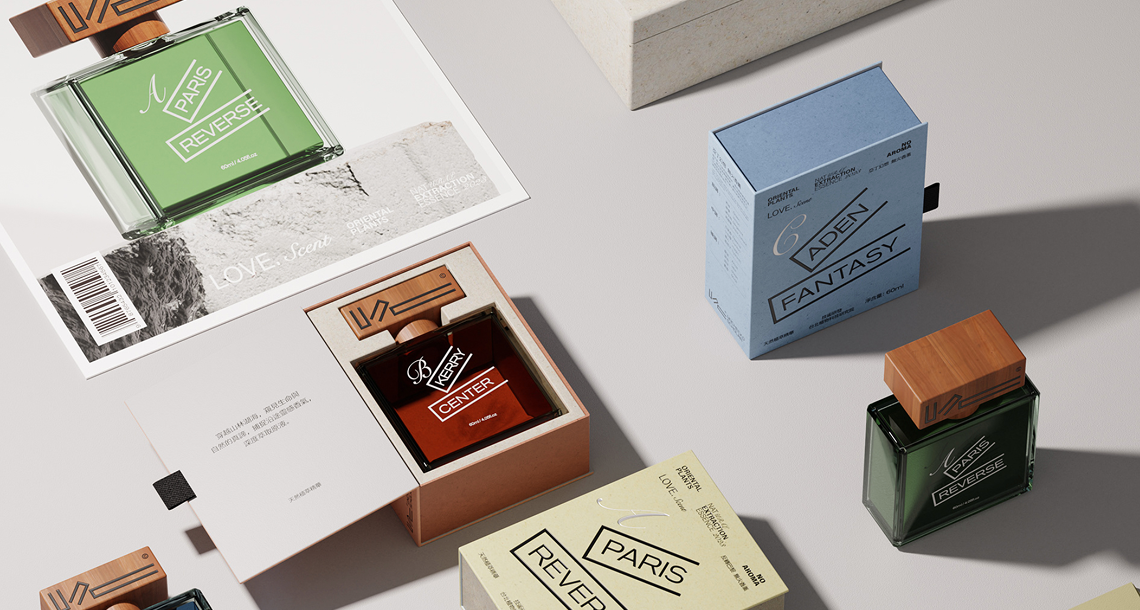

How a perfume packaging box is delivered from manufacturer to filling facility is not a logistics detail — it is a decision that affects storage costs, labor requirements, production line speed, quality risk, and total landed cost per unit. The two fundamentally different delivery configurations — flat-packed (unassembled) and formed (pre-assembled) — each have distinct advantages and trade-offs that depend on the box type, filling facility capability, and order economics.
This article explains both delivery configurations in detail, covers the equipment implications of each, and provides a decision framework for fragrance buyers selecting the right delivery method for their operation.
Flat-Pack (Knocked Down / KD) Delivery
Flat-pack delivery means the folding cartons are shipped in their flat, unfolded state — after printing, laminating, and die-cutting, but before erection. The cartons are stacked flat, bundled in specific quantities (typically 50–250 per bundle depending on board weight and caliper), wrapped in polyethylene film, and packed into outer cartons for shipping.
Advantages of Flat-Pack Delivery
- Maximum shipping efficiency: Flat cartons occupy 3–5% of the volume of the same cartons erected — 20,000 flat cartons fit into the same shipping space as 400–800 erected boxes
- Lowest freight cost per unit: Volume efficiency translates directly into reduced ocean or air freight cost
- Easiest warehouse storage: Flat bundles can be stacked on pallets and stored in standard racking with minimal space requirement
- Standard for high-volume commercial fragrance: Flat-pack delivery is the default configuration for automated cartoning lines that erect, fill, and close cartons at high speed
Requirements for Flat-Pack Delivery
Flat-pack delivery requires the filling facility to erect the cartons, either manually or using automated cartoning equipment. Automated cartoning lines (e.g., IMA, Marchesini, Uhlmann systems) erect, fill, insert components, and close folding cartons at speeds of 100–400 cartons per minute. For facilities without automated cartoning equipment, flat-pack delivery requires manual erection labor, which at low volumes can be cost-effective but at high volumes becomes a production bottleneck.
Flat-pack delivery is compatible with straight tuck-end, reverse tuck-end, crash-lock base, and auto-bottom carton styles. Auto-bottom and crash-lock designs erect by pulling the base open — no separate bottom-gluing step required — and are the most efficient for manual filling operations without cartoning lines.
Formed (Pre-Assembled) Delivery
Formed delivery means the boxes are delivered in their fully assembled three-dimensional state — erected, glued, and (where applicable) with inserts fitted. This is the standard delivery configuration for rigid boxes (setup boxes), which cannot be collapsed, and is also available for folding cartons where the buyer’s filling operation cannot accommodate flat-pack erection.
Advantages of Formed Delivery
- No erection labor required at filling facility: Boxes are ready to fill immediately on receipt
- Lower quality risk at filling stage: Pre-assembled boxes eliminate erection errors (mis-squared, un-glued bases) that can cause production line stoppages
- Mandatory for rigid boxes: Rigid boxes (setup boxes) cannot be shipped flat and must be delivered formed
- Appropriate for small-volume operations: Where filling volumes are too low to justify automated cartoning investment, formed delivery eliminates the erection labor cost
Disadvantages of Formed Delivery
- Significantly higher shipping cost: Formed boxes occupy 10–30× the shipping volume of equivalent flat-packed cartons
- Higher storage cost at filling facility: Assembled boxes require proportionally more warehouse space
- Higher damage risk in transit: Three-dimensional boxes are more susceptible to compression, corner crush, and surface finish damage than flat-packed cartons
- Surface protection required: Formed boxes with premium surface finishes (matte lamination, foil stamping) require individual wrapping or tissue interleaving to prevent surface damage in transit
Protective Packaging for Formed Box Shipments
When boxes must be shipped formed — whether rigid boxes or folding cartons for small-volume filling operations — appropriate protective packaging is essential to prevent transit damage. The standard protection hierarchy for formed fragrance packaging boxes:
- Individual tissue wrapping: Acid-free tissue around each box prevents surface abrasion between adjacent units
- Individual polybag: Provides moisture barrier and prevents surface contamination in transit
- Corrugated cell partition: Each box sits in its own corrugated cell, preventing box-to-box contact and distributing compression loads
- Outer carton specification: Double-wall corrugated outer carton, minimum BCT 800N, with ‘This Side Up’ and ‘Fragile’ labeling
Hybrid Approach: Flat-Pack with Pre-Glued Bases
A practical middle ground for many fragrance operations is the pre-glued base folding carton — the box is delivered flat but with the base already glued, meaning erection requires only pulling the base open (no base tucking or gluing at the filling stage). This configuration combines the shipping efficiency of flat-pack with a significant reduction in erection labor, and is compatible with both manual and semi-automated filling operations.
Decision Framework
- High-volume filling (10,000+ units/month) with automated cartoning line: Flat-pack delivery — maximize shipping efficiency
- High-volume filling without automated cartoning: Flat-pack with auto-bottom or crash-lock design — minimize erection labor
- Low-volume filling or complex manual assembly: Formed delivery — eliminate erection risk
- Rigid boxes (any volume): Formed delivery — no alternative
- Premium surface finish, small volume: Formed delivery with individual wrapping — protect investment
- Mixed volume operations: Discuss hybrid pre-glued base option with supplier
Conclusion
The flat-pack versus formed delivery decision has real commercial consequences for every fragrance filling operation. Getting it right reduces freight costs, storage costs, labor costs, and quality risk simultaneously. Panda Glass offers both delivery configurations for folding cartons and provides packaging engineering consultation to help buyers select the most efficient option for their specific operation. All formed box shipments include individual protective wrapping as standard. Request a delivery configuration consultation or freight cost comparison: info@pandaglass.com