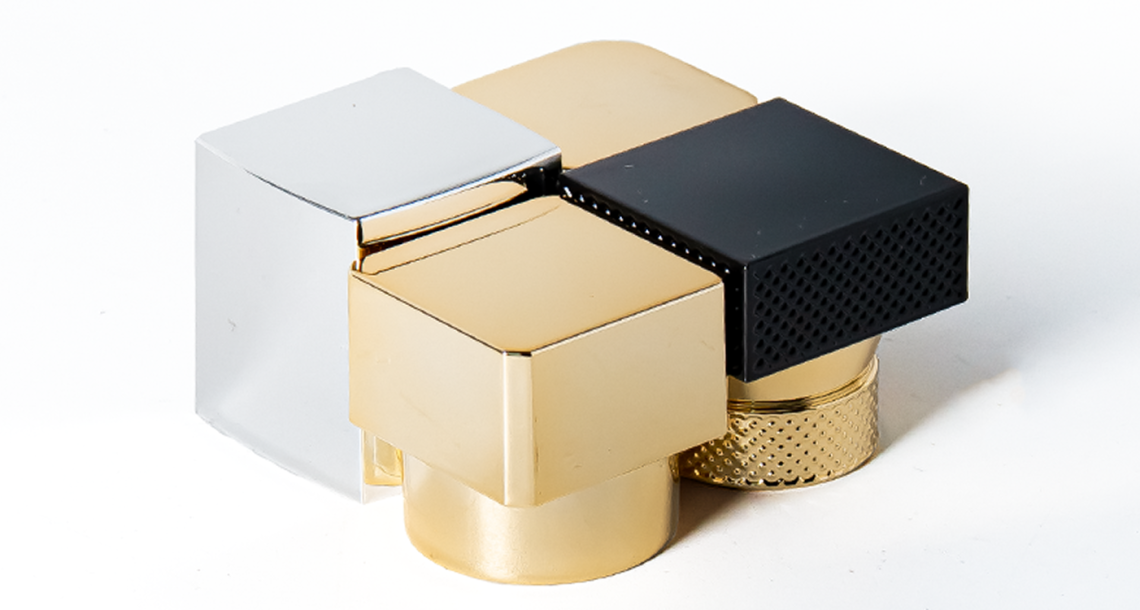
Zamak die-casting is the production process that transforms raw zinc alloy ingots into the weighted, precision-formed caps that define luxury fragrance packaging. For fragrance buyers and brand packaging engineers, understanding this process is essential context for evaluating supplier quality claims, interpreting inspection reports, and specifying tolerances that are genuinely achievable versus aspirational.
This article walks through each stage of the Zamak die-casting process for perfume caps, identifies the quality control checkpoints at each stage, and explains the defect types that distinguish premium casting from commodity production.
Stage 1 — Alloy Preparation and Melt
Production begins with Zamak 3 ingots (or recycled Zamak swarf for appropriate applications) being loaded into a holding furnace maintained at 420–440°C — just above the alloy’s melting point of 386°C. Precise temperature control at this stage is critical: overheating causes aluminium burn-off that alters alloy composition and degrades mechanical properties, while underheating produces cold-shut defects and incomplete fills in the die.
Premium manufacturers use spectrometer analysis to verify incoming alloy composition against ASTM B86 or EN 1774 standards before each production run. Buyers should request material certification documents as standard procurement documentation.
Stage 2 — Die Preparation and Injection
The steel die — a precision-machined two-part tool that defines the external geometry of the cap — is preheated to 180–220°C to prevent thermal shock when molten Zamak contacts the cold tool surface. Die release agents are applied to facilitate part ejection and protect tool surface quality.
Molten Zamak is injected into the die cavity at pressures of 15–25 MPa through a controlled gate system. Injection speed and pressure profile are programmed to ensure complete cavity fill without turbulence — turbulent flow introduces air entrapment that creates subsurface porosity, one of the most common quality defects in die-cast caps.
Stage 3 — Solidification and Ejection
Zamak solidifies rapidly — typical cycle times for a standard perfume cap are 8–15 seconds. Die cooling channels maintain precise temperature control during solidification to minimize shrinkage variation and ensure dimensional consistency across the production run. After solidification, ejector pins push the cast part from the die.
The ejected part at this stage — called a casting or rough part — still has runners, gates, and flash attached. These are removed in the next stage. Critical dimensional features are checked on the first-off part before full production proceeds.
Stage 4 — Trimming, Degating, and Flash Removal
Runners and gates are removed by trimming press. Residual flash — thin fins of metal that escaped into the die parting line — is removed by vibratory tumbling or hand finishing. The quality of flash removal is a visible indicator of production care: residual flash lines on a finished cap are an immediate quality rejection criterion in luxury fragrance applications.
After trimming, parts are inspected for completeness, gross dimensional conformity, and visible casting defects including cold shuts, shrinkage porosity, and misruns.
Stage 5 — Surface Preparation (Pre-Finishing)
Before any surface coating can be applied, the cast surface must be prepared to remove die release agent residue, oxide film, and minor surface irregularities. The standard preparation sequence for premium Zamak caps is:
- Alkaline degreasing: Removes die release agent and machining oils
- Vibratory or barrel polishing: Smooths parting line steps and micro-surface roughness
- Acid micro-etching: Creates a controlled micro-texture for coating adhesion
- Rinse and dry: Prepares the clean surface for coating application
The quality of surface preparation directly determines coating adhesion and surface finish uniformity. Under-prepared surfaces produce coating delamination, pinholes, and visible surface texture irregularities in the finished cap.
Stage 6 — Machining and Insert Processing
For caps requiring threaded inserts, precision bore machining, or press-fit plastic liners, CNC machining operations are performed after casting and before surface finishing. The internal bore of a perfume cap must be machined to precise tolerances — typically ±0.1mm on diameter — to ensure correct snap-fit or friction-fit engagement with the pump collar or bottle neck. Bore roundness and perpendicularity are critical for smooth cap application and removal.
Key Casting Defects and Their Root Causes
- Porosity: Subsurface voids caused by air entrapment during injection — root cause: turbulent fill or insufficient venting
- Cold shut: Visible seam line where two metal flow fronts met without fully fusing — root cause: low injection temperature or speed
- Shrinkage sink: Surface depression caused by volumetric contraction during solidification — root cause: inadequate die cooling or gate location
- Flash: Thin metal fins at parting line — root cause: worn die, excessive injection pressure, or inadequate clamping force
- Misrun: Incomplete cavity fill — root cause: low melt temperature, insufficient injection pressure, or blocked gate
- Warpage: Dimensional distortion after ejection — root cause: non-uniform cooling, premature ejection
Die Tooling Investment and Amortization
A Zamak cap die for a standard perfume cap design represents an investment of USD 1,500–5,000 depending on complexity, number of cavities, and design detail level. Multi-cavity dies (2–4 cavities) increase per-cycle output but require higher initial investment and more precise process control. For brands ordering 10,000+ units annually, die tooling cost per unit is negligible. For smaller brands, tooling amortization across the first production run should be clearly discussed and agreed with the supplier.
Panda Glass maintains proprietary die tooling for all catalog cap designs and offers custom die development for bespoke projects, with tooling ownership transferred to the client upon project completion.
Conclusion
Zamak die-casting is a mature, highly refined process that — when executed with precise process control and rigorous quality inspection — produces caps of exceptional quality and consistency. Understanding the process helps buyers ask the right audit questions, interpret defect reports intelligently, and set realistic tolerance expectations. Panda Glass operates die-casting lines with 100% first-article inspection and AQL-based in-line quality control throughout production.
Request casting process documentation or a factory audit appointment: info@pandaglass.com | www.pandaglass.com