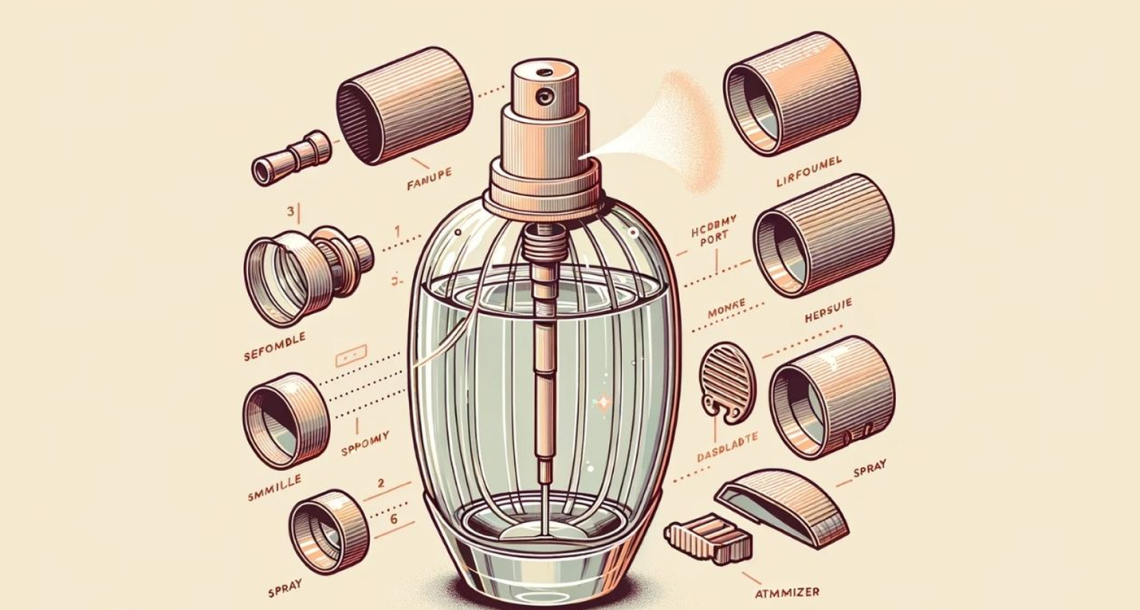
A fragrance spray pump is a compact assembly of up to 12 individual components, each serving a precise mechanical function. For packaging engineers, quality control teams, and brand procurement managers, knowing what each part does — and how it can fail — is essential knowledge for evaluating supplier quality and negotiating specifications.
This article provides a detailed component-by-component breakdown of a standard fine fragrance pump assembly, with notes on material specifications, common failure modes, and what to look for when auditing pump quality.
1. Actuator (Spray Button / Nozzle Head)
The actuator is the only externally visible pump component and the part the end user touches on every use. Its internal geometry — particularly the orifice diameter and swirl chamber design — determines mist particle size, spray angle, and spray pattern consistency. Actuators for fine fragrance typically produce a cone spray pattern at 50°–80°. The actuator material is usually polypropylene (PP) or ABS, and can be surface-finished with metallic coatings, lacquering, or UV varnish to match bottle aesthetics.
2. Outer Housing / Collar
The outer housing (also called the ferrule or pump collar) is the structural shell that houses all internal components and crimps or screws onto the bottle neck. It must maintain dimensional accuracy to the FEA15 or FEA20 standard to ensure a leak-free seal against the bottle finish. Inferior housing materials or loose tolerances result in rocking or misalignment, which compromises the seal and leads to fragrance loss.
3. Stem
The stem is a hollow tube that connects the actuator to the piston. When depressed, the stem transmits mechanical force to the piston and simultaneously serves as the fluid conduit through which pressurized fragrance travels from the pump chamber to the actuator nozzle. Stem diameter, wall thickness, and orifice geometry are tightly controlled parameters. In high-output pumps (0.15 ml per stroke), stems have larger bore diameters. In fine mist pumps, narrower bores create higher exit velocity and finer atomization.
4. Piston
The piston is the primary pressure-generating component. As the stem pushes it downward, it displaces liquid in the pump chamber. The piston must maintain a near-perfect seal against the pump cylinder bore to prevent back-flow while still sliding smoothly without excessive actuation force. Most quality pistons are manufactured from LDPE or HDPE with precise outer diameter tolerances of ±0.05mm.
5. Spring
The return spring performs two critical functions: it provides the restoring force that returns the piston to the rest position after each actuation, and it sets the minimum actuation force required to depress the pump. Stainless steel springs are preferred for alcohol-based fragrances because standard carbon steel will corrode and leave visible rust particles in the fragrance. Spring fatigue is a common failure mode in low-quality pumps — buyers should request cycle-life test data showing consistent actuation force over 10,000+ strokes.
6. Pump Cylinder (Inner Chamber)
The pump cylinder forms the sealed working chamber where liquid is compressed during each actuation stroke. Its internal bore diameter must be precisely matched to the piston OD to maintain sealing performance without creating excessive friction. Cylinder length determines the stroke volume (dosage per actuation). Material is typically PP or polyoxymethylene (POM) for dimensional stability.
7. Ball Valve (Inlet Check Valve)
A small ball — typically made from stainless steel or glass — rests in a conical seat at the base of the pump cylinder. It functions as a one-way check valve: during the downstroke it closes to prevent liquid from escaping back down the dip tube, and during the return stroke it opens to allow fresh fragrance to refill the chamber from the bottle. Ball valve seat geometry and ball diameter tolerances must be tightly controlled to prevent valve flutter or incomplete sealing, both of which cause dosage inconsistency.
8. Gasket / Seal
One or more elastomeric gaskets create the primary leak-proof seal between the pump housing and the bottle neck. For alcohol-based fragrances, gasket material selection is critical: standard rubber will swell or degrade when in contact with high-concentration ethanol. Recommended materials include EPDM, Teflon (PTFE), or specialized synthetic elastomers that have passed industry-standard alcohol soak tests. A degraded gasket is the most common cause of fragrance leakage in transit — one of the top complaints from importers and retailers.
9. Dip Tube
The dip tube is a thin plastic tube that extends from the base of the pump down to the bottom of the fragrance bottle, drawing liquid upward to the pump chamber. Dip tube length must be precisely calibrated to the bottle height — too short and the pump cannot extract the final portion of fragrance; too long and the tube buckles, restricting flow. Standard material is PP or PE. For oval, flat, or specialty bottle shapes, custom bent dip tubes are available. All Panda Glass bottles include calibrated dip tube specifications in our technical datasheets.
10. Overcap Compatibility Components
Where snap-on or screw-on overcaps are used, the pump collar must incorporate the appropriate geometry to accept the cap without interference. FEA standard overcap fittings ensure interchangeability across suppliers. For export shipments, overcaps serve a secondary function as tamper-evident seals.
Common Assembly Defects to Inspect
- Misaligned ball valve seat — causes inconsistent dosage or drip-after-spray
- Under-specification spring — causes pump to feel “loose” or fail to return fully
- Non-stainless spring in alcohol formula — causes rust contamination
- Incorrect gasket material — causes swelling, leakage, or fragrance contamination
- Dip tube length error — causes early dry-pumping or tube kinking
- Poor stem-to-piston alignment — causes side-loading, increased wear, actuation stiffness
Conclusion
Each component in a perfume pump assembly contributes to the reliability, safety, and luxury feel of the final fragrance product. Buyers who understand these components can ask the right questions during supplier evaluation, interpret technical data sheets accurately, and specify materials that are genuinely compatible with their fragrance formulas. Panda Glass provides full component-level specifications and material compliance documentation for all pump SKUs.
Request component specifications or material safety data: info@pandaglass.com | www.pandaglass.com