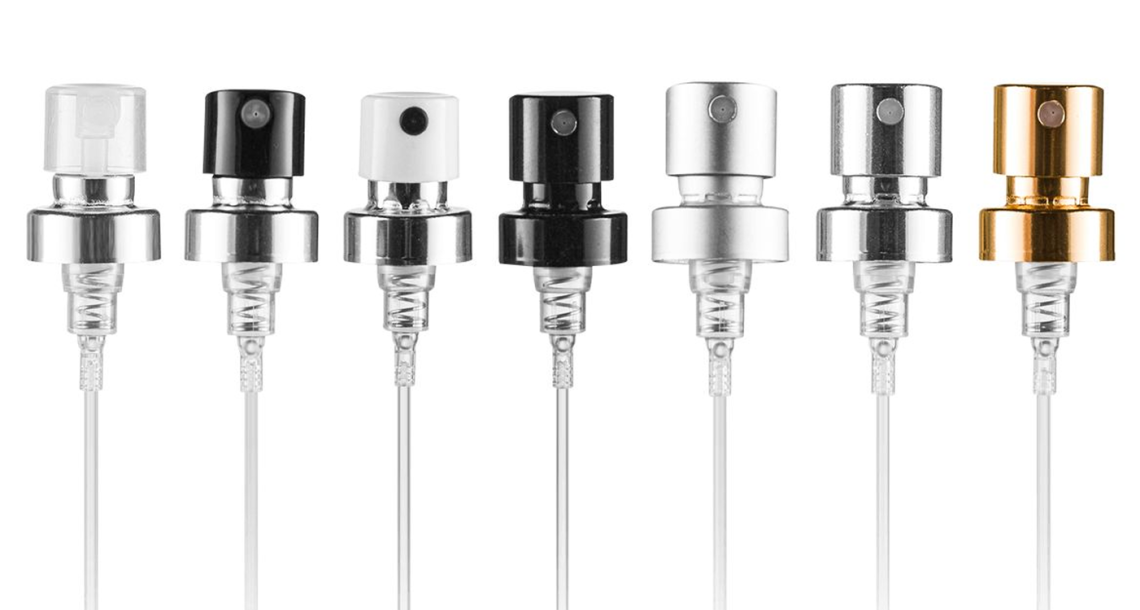
Fine fragrance formulas are typically composed of 70–90% ethanol by volume. Every internal component of a perfume pump — springs, seals, piston materials, valve seats — is in permanent, continuous contact with this alcohol solution from the moment the bottle is filled. The long-term chemical compatibility between pump materials and fragrance alcohol is not a theoretical concern; it is one of the most commercially consequential quality variables in fragrance packaging.
This article explains the failure modes caused by alcohol incompatibility, the test protocols used to evaluate pump alcohol resistance, and the material specifications that separate genuinely alcohol-safe pumps from those that will fail in the field.
How Alcohol Degrades Incompatible Pump Components
Gasket and Seal Swelling
Elastomeric seals made from standard rubber compounds — particularly natural rubber and nitrile (NBR) — absorb ethanol, causing volumetric swelling of 10–30%. A swollen gasket initially increases sealing force, which can temporarily improve leak performance. However, continued swelling causes the gasket to deform beyond its groove geometry, creating permanent deformation, loss of sealing force, and eventual fragrance leakage. This failure mode typically manifests 3–6 months after filling.
Spring Corrosion
Carbon steel springs — commonly used in low-cost pump assemblies — corrode rapidly in ethanol environments, particularly in the presence of trace moisture. Rust particles from a corroded spring contaminate the fragrance with metallic deposits that are visible as brown discoloration and are potentially harmful to consumers. This failure mode is entirely preventable through the use of 316L stainless steel springs.
Plastic Component Degradation
Certain thermoplastics used in pump cylinders and pistons — including some grades of ABS and PVC — undergo plasticizer extraction in high-ethanol environments. This results in dimensional shrinkage of the component, micro-cracking of the surface, and leaching of plasticizer compounds into the fragrance. The result is degraded pump function and potential fragrance contamination with taste and odor compounds. PP and HDPE are the materials of choice for alcohol-exposed pump internals.
Surface Finish Delamination
On pump exteriors, ethanol exposure — whether from fragrance splash-back during filling or from consumer handling — can attack coating adhesion if the surface treatment was not formulated for chemical resistance. UV-cured coatings with cross-linked polymer networks offer superior alcohol resistance versus conventional solvent-based lacquers.
Industry-Standard Alcohol Resistance Test Protocols
Static Soak Test
The most fundamental alcohol resistance test involves immersing pump assemblies or component samples in a test solution — typically 75% IPA (isopropanol) or 90% ethanol — for a specified duration (usually 72 hours, 7 days, or 30 days). After immersion, components are removed, dried, and evaluated for dimensional change, weight change, surface deterioration, and functional performance. ISO 175 provides the standard methodology for plastics immersion testing.
Dynamic Cycle Test with Alcohol
A more realistic evaluation involves loading pump assemblies with an alcohol test solution and then performing repeated actuation cycles — typically 5,000 to 30,000 strokes — while measuring dosage output consistency, actuation force change, and leak performance at regular intervals. Pumps that pass this protocol demonstrate both material compatibility and mechanical endurance in a combined alcohol environment.
Filling Line Simulation
Premium suppliers additionally simulate the fragrance filling process — where pumps may be exposed to splash or drip of fragrance concentrate during high-speed line filling — and evaluate whether exterior coating adhesion is maintained. This test is particularly relevant for pumps with metallic or matte surface finishes.
Material Specifications for Alcohol-Safe Pump Components
- Springs: 316L stainless steel — mandatory for all alcohol-contact applications
- Seals and gaskets: EPDM, PTFE (Teflon), or silicone — avoid NBR and natural rubber
- Pump cylinder and piston: PP (polypropylene) or HDPE — avoid PVC and standard ABS
- Ball valve: Stainless steel or borosilicate glass ball — avoid standard carbon steel
- Exterior coatings: Cross-linked UV lacquer with ≥100-rub IPA resistance certification
What Buyers Should Demand from Suppliers
When evaluating pump suppliers for fragrance applications, the following documentation requests are entirely reasonable and should be provided without hesitation by any serious manufacturer:
- Material safety data sheets (MSDS) for all alcohol-contact pump components
- Alcohol soak test reports (75% IPA, minimum 7 days) with dimensional change data
- Spring material certification confirming 316L stainless steel grade
- Gasket material confirmation with EPDM or PTFE specification
- Cycle-life test report with fragrance simulant (minimum 10,000 strokes)
Real-World Consequences of Alcohol Incompatibility
The commercial consequences of deploying alcohol-incompatible pump components are severe: fragrance contamination complaints, retailer returns, brand reputation damage, and in worst cases, consumer safety incidents from metallic spring corrosion particles. The cost differential between a properly specified alcohol-safe pump and a commodity alternative is typically less than USD 0.05–0.10 per unit — negligible compared to the cost of a recall or brand damage event.
Conclusion
Alcohol resistance is not a premium specification — it is a baseline requirement for any pump deployed in a fine fragrance application. Buyers who verify material specifications and demand documented test data are not being demanding; they are being professionally responsible. Panda Glass supplies pumps with full alcohol resistance documentation, including 316L stainless steel springs and EPDM seals as standard for all fragrance-grade pump SKUs.
Request alcohol resistance test reports or material specifications: info@pandaglass.com | www.pandaglass.com